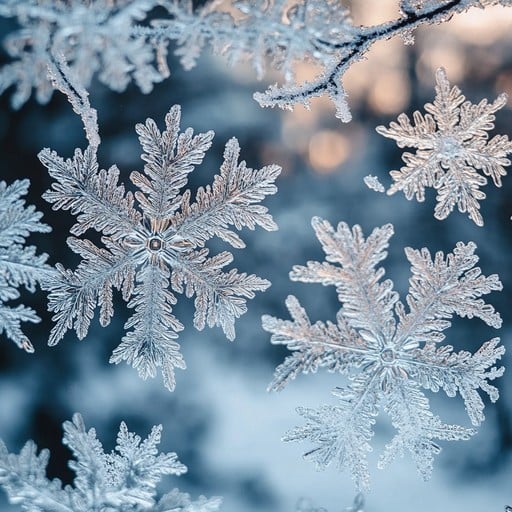
The Formation of Snowflakes: Nature’s Frozen Artistry
On a cold winter day, the sky turns heavy with clouds, and soon delicate flakes drift down, swirling gently toward the ground. Catch one on your glove or sleeve, and for a brief second, you glimpse a miracle: a tiny, intricate crystal, so detailed it looks as if it were carved by the hand of an artist. Then it melts away, leaving nothing but a memory.
Snowflakes are among the most ordinary things in winter, yet they are also among the most extraordinary. Each one is a masterpiece of physics and chance, a frozen story written in air and water.
The Birth of a Snowflake
Every snowflake begins with something impossibly small: a speck of dust or pollen floating in the clouds. Around this tiny seed, water vapor gathers, clinging and freezing into ice. At first, the crystal is simple — just a hexagon, the natural shape water molecules form when they solidify.
From this point on, the snowflake’s journey depends on its path through the cloud. The air’s temperature and humidity guide how the crystal grows. In some conditions, thin plates form; in others, branching arms stretch outward. A single snowflake may tumble through pockets of air warmer or colder, wetter or drier, each shift changing its growth. The result: endless variety.
Why Six Sides?
Almost every snowflake has six sides or branches. This is because of the way water molecules lock together when they freeze, creating a six-fold symmetry. Yet within that simple rule, the possibilities are nearly infinite. No two snowflakes are ever exactly alike — not because it’s impossible, but because the odds are so staggeringly small. Millions of conditions influence each flake’s growth, making repetition almost unthinkable.
Patterns in the Cold
Scientists have mapped how temperature shapes snowflakes:
-
At about -2°C, they form thin, flat plates.
-
At -5°C, long, slender needles grow.
-
Around -15°C, the classic star-shaped, branching crystals emerge.
-
Below -30°C, snowflakes can become almost column-like.
What we see falling from the sky is a collection of crystals, each carrying the memory of the air it traveled through.
A Dance of Chance
The beauty of a snowflake is in its unpredictability. A tiny shift in humidity or a slight change in the air’s temperature alters the entire design. That’s why two flakes starting side by side can end up utterly different by the time they land. Each one is a frozen fingerprint of the atmosphere, unique to its moment of creation.
A History of Wonder
For centuries, people have marveled at snowflakes. In the 17th century, Japanese scientist Dai Seikei sketched their patterns, trying to classify them. Later, in the 1600s, Johannes Kepler — better known for his work on planetary motion — pondered why they always had six sides. In the 19th century, Vermont farmer Wilson Bentley became the first to photograph snowflakes under a microscope, revealing their stunning diversity to the world. He famously said, “No two snowflakes are alike.”
More Than Beauty
Snowflakes aren’t just pretty; they shape the world around us. Their intricate crystals trap air, giving snow its insulating properties — protecting plants, animals, and even human dwellings under a soft blanket. Snow helps regulate Earth’s climate by reflecting sunlight back into space. Each flake, delicate on its own, becomes part of a force that shapes ecosystems and weather patterns.
The Ephemeral Masterpieces
Perhaps what makes snowflakes so magical is their impermanence. They are born in clouds, fall to Earth, and vanish with warmth. To hold one is to hold something fleeting, as fragile as a breath. Yet in that brief moment, you are touching a piece of geometry crafted by nature’s unseen hand.
Snowflakes remind us that beauty does not need to last to matter. Even in their disappearance, they leave wonder behind.
The Silent Gift of Winter
The next time snow falls, pause for a moment. Catch a flake. Look closely. In your hand rests not just ice, but a story of clouds, air, and chance — a pattern that will never be repeated in the same way again.
The formation of snowflakes is the Earth’s quiet artistry, sculpted from water and air, proof that even the smallest things can hold infinite beauty.
via ChatGPT |