The gallery with all subgalleries and compositions will be permanently deleted and cannot be recovered. Are you sure?
Executing...

Name or e-mail of your friend, to whom the message will be sent:

Please, edit the text of the message you are about to send.

The evolution of the guitar over centuries

Sonya

The Evolution of the Guitar Over Centuries

The guitar as we know it — with six strings, a flat body, and a vast range of musical styles — is the result of centuries of cultural exchange, craftsmanship, and innovation. From ancient ancestors with gut strings to today’s high-tech electric models, the guitar’s journey reflects changes in music, technology, and taste.


1. Ancient Relatives: The Guitar’s Distant Family Tree

Long before the modern guitar, many cultures had plucked string instruments:

  • Ancient Egypt (c. 1500 BCE) had wooden instruments with animal gut strings.

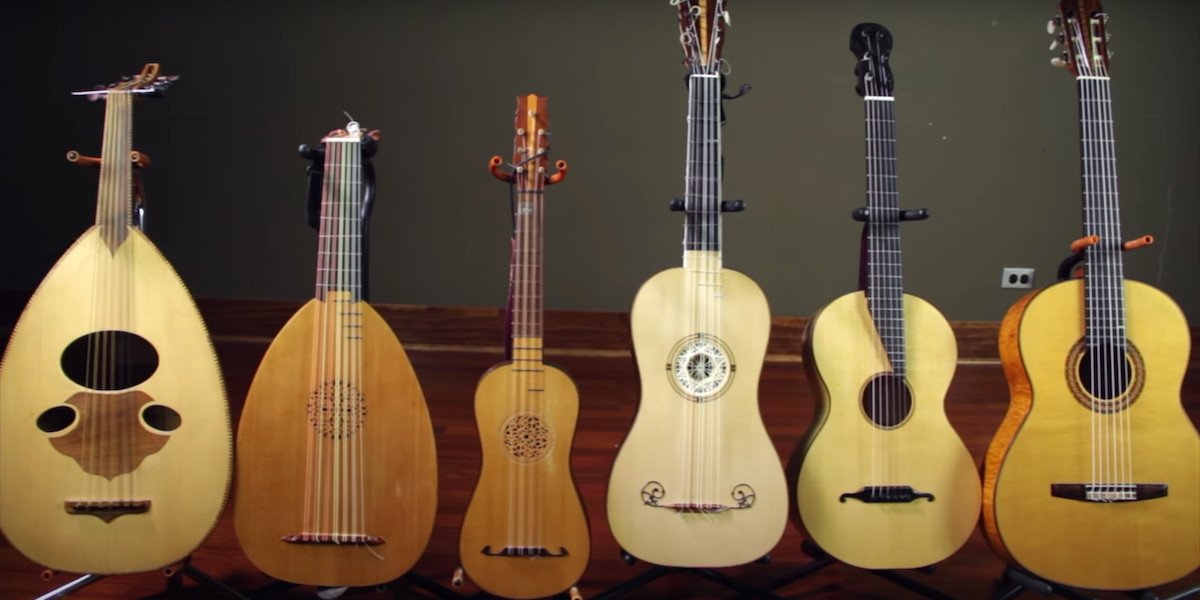
  • The Oud – Originating in the Middle East, fretless and pear-shaped, it spread into Europe during the Middle Ages.

  • The Lute – Popular in Renaissance Europe, with a rounded back and multiple strings, it was the direct inspiration for early guitars.


2. The Renaissance & Baroque Guitars (15th–17th centuries)

By the 1500s, the vihuela in Spain and the Renaissance guitar elsewhere were becoming popular.

  • Vihuela – Tuned like a lute but shaped more like today’s guitar.

  • Baroque Guitar – Typically had five courses (pairs) of gut strings and elaborate decorative inlays.
    These instruments were smaller than modern guitars, with a lighter, more delicate tone.


3. The Birth of the Six-String Guitar (Late 18th–Early 19th centuries)

The five courses gradually became six single strings, giving players greater melodic range and simplifying tuning.

  • Spanish makers like Antonio de Torres in the mid-1800s perfected the classical guitar design — larger body, fan bracing for better resonance, and standard tuning (E–A–D–G–B–E) still used today.


4. The Romantic Era & the Rise of the Guitar’s Popularity

During the 1800s, the guitar moved from folk gatherings into salons and concert halls.

  • Composers like Fernando Sor and Mauro Giuliani elevated the guitar to a respected classical instrument.

  • Steel strings began replacing gut in some regions, producing a louder, brighter sound for folk and popular music.


5. The Birth of the Acoustic Guitar (Late 19th–Early 20th centuries)

  • In the U.S., companies like C.F. Martin & Co. developed X-bracing, which strengthened the top for steel strings.

  • The dreadnought body style (introduced in 1916) gave even greater volume, perfect for singers and folk players.


6. The Electric Revolution (1930s–1950s)

  • The first commercially successful electric guitars appeared in the 1930s — like the Rickenbacker “Frying Pan”, a lap steel guitar with magnetic pickups.

  • In 1950, Leo Fender introduced the Broadcaster (later the Telecaster), a solid-body electric that changed popular music forever.

  • Gibson’s Les Paul model followed, giving a warmer, sustaining tone that became iconic in rock and jazz.


7. The Guitar in the Rock Era (1960s–1980s)

  • Electric guitars became cultural symbols thanks to players like Jimi Hendrix, Eric Clapton, and Jimmy Page.

  • Innovations like whammy bars, distortion pedals, and multi-effects units expanded the guitar’s sonic possibilities.


8. The Modern Guitar (1990s–Today)

  • Hybrid models combine acoustic and electric features.

  • Advances in materials (carbon fiber, synthetic composites) offer durability and new tonal options.

  • Digital modeling technology can now make a single guitar sound like dozens of different instruments.


9. A Global Instrument

Today, the guitar is at home in virtually every genre: flamenco in Spain, samba in Brazil, blues in the American South, heavy metal in Europe and Japan. Its adaptability is unmatched.


Fun Facts


  • The world’s largest playable guitar is over 13 meters (43 feet) long.

  • A standard guitar fretboard has 12 frets before the octave, but extended-range guitars can have 24 or more.

  • The strings on early guitars were made from sheep intestine, known as catgut (despite the name, cats were never involved).


via ChatGPT

Author:   Sonya  Version:  1  Language: English  Views: 0

 Rating:  0 by 0

Picture: Source: https://www.google.com/url?sa=i&url=https%3A%2F%2Fwww.musicmaker.ie%2FThe-History-and-Evolution-of-the-Acoustic-Guitar%3Fsrsltid%3DAfmBOop2Xv3fhoYqsUBt-iFBLCEgTCr7W4Kg_VLunaux6ybh23HuXS3M&psig=AOvVaw1rEx9RjjiM0_1vsxDXQpQl&ust=1755275712595000&source=

Short link: https://www.sponsorschoose.org/a372
Short link to this version: https://www.sponsorschoose.org/n403
Created by Sonya at 2025-08-14 09:38:08
Last modified by Sonya at 2025-08-15 17:06:26