Ця галерея з усіма галереями та композиціями всередині її буде вилучена і не може бути відтворена. Ви впевнені?
Виконання...

Ім'я або е-мейл вашого друга, кому буде надіслано це повідомлення:

Будь ласка, відредагуйте текст, як ви бажаєте.

The evolution of the guitar over centuries

Sonya

The Evolution of the Guitar Over Centuries

The guitar as we know it — with six strings, a flat body, and a vast range of musical styles — is the result of centuries of cultural exchange, craftsmanship, and innovation. From ancient ancestors with gut strings to today’s high-tech electric models, the guitar’s journey reflects changes in music, technology, and taste.


1. Ancient Relatives: The Guitar’s Distant Family Tree

Long before the modern guitar, many cultures had plucked string instruments:

  • Ancient Egypt (c. 1500 BCE) had wooden instruments with animal gut strings.

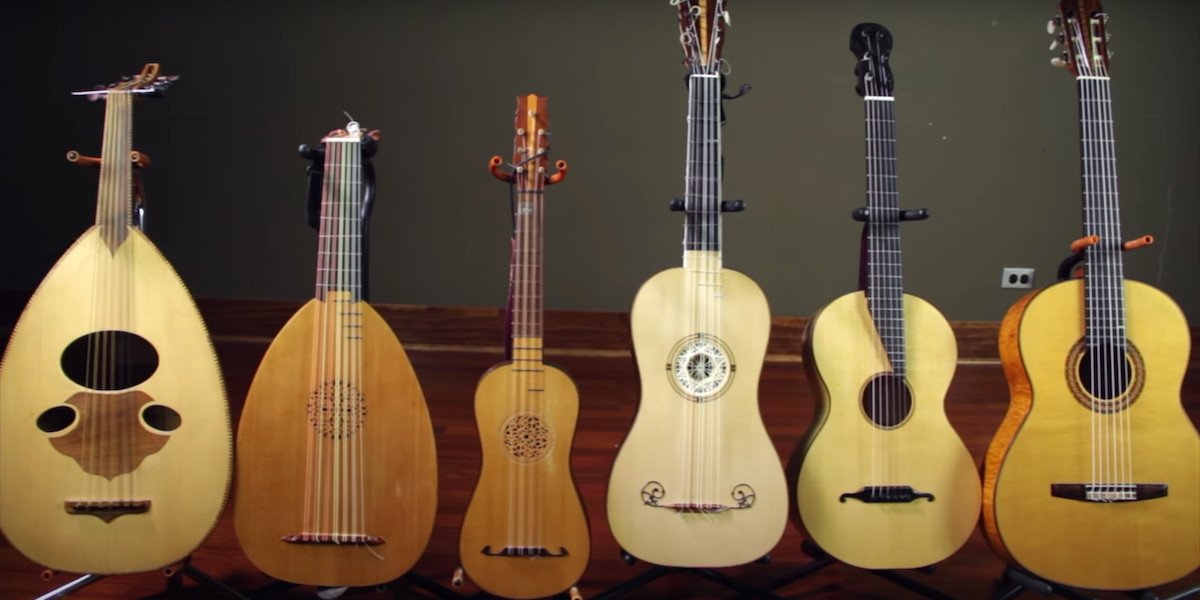
  • The Oud – Originating in the Middle East, fretless and pear-shaped, it spread into Europe during the Middle Ages.

  • The Lute – Popular in Renaissance Europe, with a rounded back and multiple strings, it was the direct inspiration for early guitars.


2. The Renaissance & Baroque Guitars (15th–17th centuries)

By the 1500s, the vihuela in Spain and the Renaissance guitar elsewhere were becoming popular.

  • Vihuela – Tuned like a lute but shaped more like today’s guitar.

  • Baroque Guitar – Typically had five courses (pairs) of gut strings and elaborate decorative inlays.
    These instruments were smaller than modern guitars, with a lighter, more delicate tone.


3. The Birth of the Six-String Guitar (Late 18th–Early 19th centuries)

The five courses gradually became six single strings, giving players greater melodic range and simplifying tuning.

  • Spanish makers like Antonio de Torres in the mid-1800s perfected the classical guitar design — larger body, fan bracing for better resonance, and standard tuning (E–A–D–G–B–E) still used today.


4. The Romantic Era & the Rise of the Guitar’s Popularity

During the 1800s, the guitar moved from folk gatherings into salons and concert halls.

  • Composers like Fernando Sor and Mauro Giuliani elevated the guitar to a respected classical instrument.

  • Steel strings began replacing gut in some regions, producing a louder, brighter sound for folk and popular music.


5. The Birth of the Acoustic Guitar (Late 19th–Early 20th centuries)

  • In the U.S., companies like C.F. Martin & Co. developed X-bracing, which strengthened the top for steel strings.

  • The dreadnought body style (introduced in 1916) gave even greater volume, perfect for singers and folk players.


6. The Electric Revolution (1930s–1950s)

  • The first commercially successful electric guitars appeared in the 1930s — like the Rickenbacker “Frying Pan”, a lap steel guitar with magnetic pickups.

  • In 1950, Leo Fender introduced the Broadcaster (later the Telecaster), a solid-body electric that changed popular music forever.

  • Gibson’s Les Paul model followed, giving a warmer, sustaining tone that became iconic in rock and jazz.


7. The Guitar in the Rock Era (1960s–1980s)

  • Electric guitars became cultural symbols thanks to players like Jimi Hendrix, Eric Clapton, and Jimmy Page.

  • Innovations like whammy bars, distortion pedals, and multi-effects units expanded the guitar’s sonic possibilities.


8. The Modern Guitar (1990s–Today)

  • Hybrid models combine acoustic and electric features.

  • Advances in materials (carbon fiber, synthetic composites) offer durability and new tonal options.

  • Digital modeling technology can now make a single guitar sound like dozens of different instruments.


9. A Global Instrument

Today, the guitar is at home in virtually every genre: flamenco in Spain, samba in Brazil, blues in the American South, heavy metal in Europe and Japan. Its adaptability is unmatched.


Fun Facts


  • The world’s largest playable guitar is over 13 meters (43 feet) long.

  • A standard guitar fretboard has 12 frets before the octave, but extended-range guitars can have 24 or more.

  • The strings on early guitars were made from sheep intestine, known as catgut (despite the name, cats were never involved).


via ChatGPT

Автор:   Sonya  Версія:  1  Мова: Англійська  Переглядів: 0

 Рейтінг:  0 від 0

Рисунок: Посилання на джерело: https://www.google.com/url?sa=i&url=https%3A%2F%2Fwww.musicmaker.ie%2FThe-History-and-Evolution-of-the-Acoustic-Guitar%3Fsrsltid%3DAfmBOop2Xv3fhoYqsUBt-iFBLCEgTCr7W4Kg_VLunaux6ybh23HuXS3M&psig=AOvVaw1rEx9RjjiM0_1vsxDXQpQl&ust=1755275712595000&source=

Коротке посилання: https://www.sponsorschoose.org/a372
Коротке посилання на цю версію: https://www.sponsorschoose.org/n403
Автор - Sonya дата: 2025-08-14 09:38:08
Остання зміна - Sonya дата: 2025-08-15 17:06:26